Companion Episode: Going Round in Circles
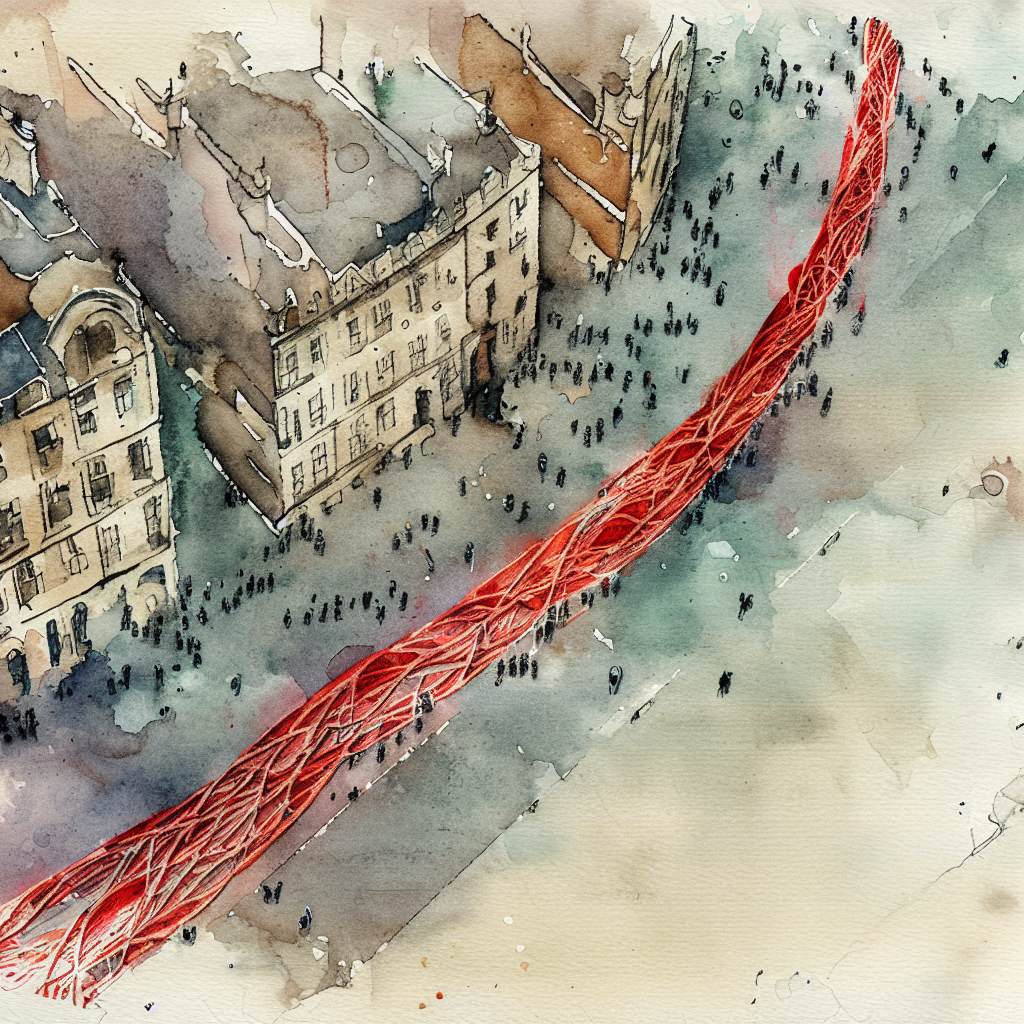
When the Queen died, they displayed her coffin “lying in state” in central London. The queue to visit stretched, at its peak, to ten miles, with a 24 hour wait. I decided to visit the queue, and walk alongside it for a while, capture a unique historical moment, and recorded it with some binaural microphones I’d been meaning to try out.
I probably shouldn’t have been, but I was surprised that London – and the UK – had that many monarchists. It struck me that as well as those people, there were probably some people who were coming along because it was a historic moment they wanted to be part of, irrespective of their feelings about the monarchy. And there were people like me, interested in the queue as a weird phenomenon in itself. And that in itself a bit like a snake eating its own tail, and that led me to the daydream of a queue that was actually chasing its own tail, people looped around into an endless wait, an idea that’s represented in my monologue.
My original idea was to write a bunch of monologues on this topic that could be looped across multiple episodes, but I didn’t like my ideas much and I thought it would be much more interesting to open it to my favourite poets, audiomakers, comedians and writers. Given the prompt “Going Round in Circles”, a time limit, and an invitation to record with some background sound, we got 17 diverse monologues†, from marching songs to magic realist fiction to travelogues to personal reflections and reactions to their environment and circumstances. Three of the monologues – mine, Jeff’s, and the one written by friend of the show Adriene Lily – were created in segments, so they could start at different points (e.g. ABCD or BCDA or CDAB or DABC, for a four-part monologue). The permutation is different each time the monologue appears.
What else is going on? Well, the episode is a development of the “waves” format. The idea is that each monologue shifts into focus and out again over its tenure in the episode (which is six days). Let’s say you tune in one day, and you hear three monologues in the episode.
- Monologue 1 is panned off to the right, and is very trebley. Monologue 2 is in the centre of the stereo image, and is clearly audible. Monologue 3 is off to the left, and very muffled.
- As days pass, Monologue 1 disappears; Monologue 2 gets more trebley and moves to the right; and Monologue 3 moves towards the centre and becomes less muffled.
- After 3 days, Monologue 2 is trebley and panned right; Monologue 3 is clear and in the centre; and there’s a new monologue, Monologue 4, panned left and muffled.
Behind the scenes, there’s a pan law*, and a bandpass filter that starts around 5-200Hz when the monologue is first introduced, and ends up around 8-32kHz on its final day, dictated by a power law – both a function of the number of days elapsed. Finally, on any one day, two versions of each monologue are generated – one panned a bit more to the left with a slightly lower bandpass, and one panned a bit more to the right with a slightly higher bandpass, and the episode fades between the two. This gives a subtle sense of the monologue shifting from left to right and from muffled to clearer, or clear to thinner, over the course of an individual episode.
This part was reasonably easy to implement, what was harder was gain staging. Aggressive bandpassing absolutely knackers your PLR, it turns out*, so getting any kind of consistent loudness in the final episodes was very challenging.
The music is fun. It’s one relatively short piece, with several different layers (guitars, percussion, bass, mellotron). It chooses a random tempo and stretches/repitches the music each time. It also picks different instrumental parts each loop, layering them up each time around. The tone is very different depending on whether it starts with rhythm guitar, or mellotron, or the sound of me banging the spring on my mic arm. There’s also a percussive track later on that’s made from samples of the background sounds from the monologue recordings.
And there’s ambience drawn from all of the monologues featured that day. This isn’t bandpassed, so you might clearly hear the sound of the steam clock Hannah McGregor recorded in Vancouver, and the wind in the trees around Fil Corbett’s home in Nevada, even though the only monologue you can hear clearly that day is Dave Pickering’s as they walk along a busy Yorkshire road. I really like the juxtaposition of different voices, places, and accents – occasionally they clash and that clash is kind of intriguing (would you really hear the birdsong Camilla Hannan captured in a Melbourne park in the airport Vera Chok is recording in?) but other times it just creates a slightly amorphous sense of place, and for me, a sense of connection. “Going Round In Circles” brings to my mind a sort of stuckness and frustration – framed by its inspiration in The Queue and the hangover of COVID – but I’m glad people expanded out of this negative association – into Joanna Neary’s snail-like Paris, Jess Shane’s hero’s journey, Mike Williams’ perambulations around his neighbourhood, Emily Candela’s war with roundabouts. It’s very meta – not deliberately so – because Neutrinowatch is always going round in circles. If it arrives, the next day it must depart – on the road, that’s where it longs to be.
†so far
*this is a sigmoid function of elapsed days, for reasons only Past Marty knows
**the pydub audio library has methods to convert its native audiosegments to numpy arrays (albeit with a need for some de-interlacing) and scipy has high, low and band-pass methods. I wrote utility methods that allow the http://segment>numpy%20array>scipy%20filter>processed%20numpy%20array>audio%20segment pipeline to be wrapped into a function a while ago.
***PLR, or peak to loudness ratio, is a ratio of (usually integrated) loudness to peak level. I find it useful in this context because it tells you how loud the sound would be if you max out the volume without clipping. e.g. it’s fine (generally) if your loudness is -30LUFS if your peak level is -15dB, because it means you can turn up the level by 14dB and have a signal with a loudness of -16LUFS and still have 1dB of headroom. Unfortunately bandpassing can knock 4-6 dB off your PLR, so a nice loud -14PLR signal can turn into a -20PLR signal.

 Neutrinowatch Podcast
Leave a comment